
Order a "Margherita" in Naples and order a "Margherita" from a pizza chain in Bengaluru, and you'll likely get two very different pizzas. Same name, same basic idea — flatbread, sauce, cheese — but the crust underneath tells a completely different story.
Neither version is wrong. They're built for different palates, different histories, and different expectations of what pizza should feel like. Here's what actually separates the two, and why the crust is where the difference shows up first.
| Attribute | Italian Pizza (Neapolitan/Roman) | Indian-Style Pizza |
|---|---|---|
| Crust thickness | Thin, with a puffed, airy edge | Often thicker and softer throughout |
| Fermentation | Long, slow — hours to days | Typically shorter, faster-rising dough |
| Topping philosophy | Minimal — a few quality ingredients | Generous — layered, heavier toppings |
| Cheese | Moderate, often fresh mozzarella | Heavier, sometimes multiple cheese blends |
| Sauce style | Simple tomato, lightly seasoned | Often sweeter and more heavily spiced |
| Cooking method | Wood-fired, very high heat, quick bake | Often a standard oven or tandoor-style setup |
Traditional Italian pizza, especially Neapolitan and Roman styles, is built around the idea that the dough is the star. A long, natural fermentation — sometimes stretching well beyond a day — develops flavour in the crust itself, so it doesn't need to be buried under toppings. Add too much on top, and that thin, airy structure simply can't hold it.
That's why an authentic Margherita has just tomato, mozzarella, and basil. It's not restraint for its own sake — the crust has already done most of the flavour work.
Indian-style pizza developed differently, largely shaped by global pizza chains adapting their product for local taste. A thicker, softer base holds up better under generous cheese, sweeter tomato sauce, and bolder, more heavily spiced toppings — flavours that align more closely with what many Indian diners were already used to.
It's a genuine adaptation, not a lesser version. The thicker crust exists because it's built to carry a completely different flavour profile — one designed around abundance and spice rather than restraint.
"One crust is built to disappear behind bold toppings. The other is built to be the main event."
Both are real — they're just answering different questions. Italian pizza asks how little you can add while still making something remarkable. Indian-style pizza asks how much flavour you can pack onto a base built to support it. Neither approach is right or wrong; they simply come from different food cultures with different ideas of what a good bite should feel like.
Italian dough is given hours, sometimes days, to ferment naturally — building flavour and structure that a quick-rise Indian-style base doesn't have time to develop.
A thicker Indian-style base is engineered to carry heavier toppings without going soggy — a practical adaptation for a very different topping style.
Wood-fired ovens cook Italian pizza fast and hot, setting a thin crust almost instantly — a very different process from the slower bakes common in Indian-style pizza kitchens.
Italian pizza lets the crust and a few ingredients speak for themselves. Indian-style pizza is built around bold, layered flavour from the toppings up — both valid, just different goals.
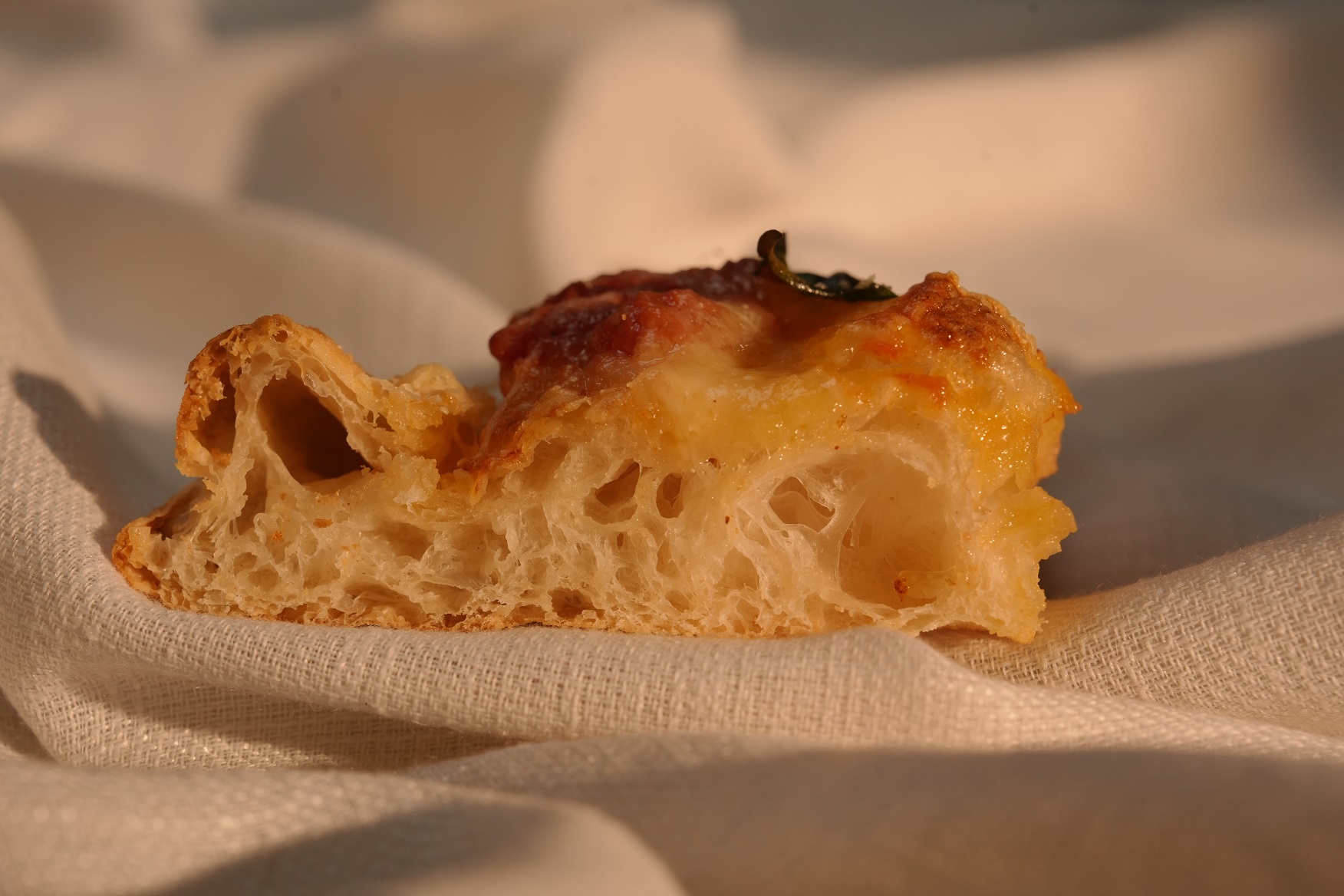
At Eatinn' Love Trattoria, we follow traditional Italian technique — naturally fermented Neapolitan sourdough and Roman-style Pala Romana, baked fresh in a wood-fired oven. It's a deliberate choice to keep the crust doing what it was always meant to do.
Explore Our Pala RomanaWhy is the crust different between Italian pizza and Indian-style pizza?
Italian pizza, especially Neapolitan and Roman styles, relies on long fermentation and minimal toppings to let a thin, airy crust shine. Indian-style pizza often uses a thicker, softer base designed to carry heavier loads of cheese, sauce and toppings suited to local tastes.
Is Indian-style pizza the same as Italian pizza?
Not quite. Indian-style pizza is a genuine adaptation — built around bolder spice, sweeter tomato bases and generous cheese to suit local preferences — while Italian pizza generally favours simplicity, letting the dough, sauce and a few quality toppings speak for themselves.
What kind of crust does Eatinn' Love Trattoria use?
Eatinn' Love Trattoria follows traditional Italian technique — naturally fermented Neapolitan sourdough and Roman-style Pala Romana — baked in a wood-fired oven for an authentic thin, airy crust.